Showing posts with label Discrimination. Show all posts

Thursday, 3 November 2022

The business of race


Of recent Kanye West has been talking out of his ass and stirring up a lot of controversy with threatening and offensive pronouncements about Jews. A lot of his behaviour and what he has been saying has strong hints of clinical paranoia. People have turned on him in droves and he has not made much of an effort to make amends or row back his comments. Multiple businesses and organisations have ended relationships with him in response to the public outcry. He is clearly being hit in the pocket by the reactions to his unconscionable utterances but his reputation is taking an even bigger battering. It remains to be seen if there is any way back for him from casting out that he is currently going through. 

Kanye has been accused of stirring up anti-semitism and giving license to fascists and nazis to show off their bigotry. This might be a bit of a reach because fascists have never needed any encouragement to abuse or attack Jews. While fascists might wholeheartedly agree with Kanye it would appear he is actually getting more obvious and vocal support from Republicans. Republicans have literally hoisted Kanye on their shoulders and showed him around as their gladiator in their war against “wokeness”. While the mainstream is working overtime to cancel Kanye the Republicans are promoting him for all they’re worth. 

Kanye West is currently topping the unpopularity charts but he has an extensive back catalogue of bigoted declarations dismissing the suffering of Black people and criticising the response to historic abuses, and icons in the civil rights struggle. He also routinely mistreats and verbally abuses Black people and women he comes across. It is interesting that even when he was at his most obnoxious he did not receive the wholesale disapproval he is currently experiencing. In fact, businesses were falling over themselves to throw money at him for his questionable creative endeavours. Whether you call him a maverick or a moron businesses had no problem making money off him while Black people and women were the targets of his unsavoury sayings. 

It is only too right that Kanye West is facing censure for his anti-semitism. His behaviour thoughtless and feeds into harmful stereotypes of Jews. However, it is problematic that society in general is a lot more tolerant of prejudice when it is directed at other minorities. We have seen mainstream right wing personalities and politicians try to downplay the murder of George Floyd and the GOP in America have launched an all out onslaught on Critical Race Theory. A lot of the right wing outrage is a concerted effort to deny the reality of prejudice and discrimination suffered by Black people in America. A lot more could be done to address racial inequality and tensions but they would rather put all that effort into covering it up. 

The U.K.’s prime minister’s office recently released a statement saying that Rishi Sunak; the prime minister, does not consider the U.K. a racist country. While it is true that not all people are racist certain groups definitely are and the institutions still show evidence of systemic racism. Health inequalities, disproportionate involvement in criminal justice system, the ‘Windrush Scandal’, and the current animosity towards Critical Race Theory are strong indications of that. These are permitted to persist because the environment we’re in allows it. There is such a strong undercurrent of prejudice towards Black people that many cases of subtle or overt racism towards Black people barely cause a ripple. The business community has figured out that they are better off covering up or just ignoring the issue. Maybe this was what Kanye was hoping for when he decided to give vent to his inner voice. 

Tuesday, 31 August 2021

Manning Up


Black people face a lot of challenges in today’s world. Advancing themselves and uplifting their communities while dealing with personal demands and institutional prejudice place quite a strain on individuals. Tragically Black males have been frequently known to get involved in criminality, drugs and gender based violence. This comes out of a culture of toxic masculinity that has normalised both misogynistic and anti-social behaviour.

It needs to be acknowledged that too many young Black males are overly invested in living out a ‘gangsta’ fantasy. It is so bad that a majority of them are so committed to it that they can’t see any reason why it isn’t a viable life choice. If you add the lack of any real ambition outside of making quick money, and toxic masculinity to the equation; we are now dealing with a young underclass that cannot see the potential of a big blue sky and instead is settling for a hole in the ground. 

The double whammy of materialism and violence has had a detrimental effect on Black families and women. Not only is the behaviour of Black males devastating domestic family life, it is also tearing apart the community fabric that Black people have been so dependent on for survival. This is not to say that there aren’t negative external pressures that are hurting the Black society. Racism, poverty, discrimination, unemployment, low educational achievement are equally problematic. However Black males have become an issue that we can no longer ignore. 

The corruption of the Black male psyche is a generational issue that has created an endemic problem. It is difficult to expect more when the individuals have very little self worth and awareness. If all they value are material things and machismo then by adulthood we are being left with too many lost causes. The numbers of Black men not in education or employment, involved in the criminal justice system or who have a history of abuse and violence speak for themselves. 

There aren’t any miracle cures for the problem but families have a responsibility to instil good values in their youth. The Black community also needs to do a better job of promoting wholesome role models. People who know the harm that systemic racism has been doing but are still committed to improving themselves and the people around them. Being a better man is not about being a superstar it’s about supporting yourself and those people you come into contact with. 

Tuesday, 25 May 2021

The View from the Top

© Guardian 

The U.K. government’s commission on race equality produced a report that concluded that institutional racism was no longer a thing in Britain, and Britain is an exemplar nation for race equality and integration.  It should probably be enough to delve into the membership of the commission to roundly discredit its findings and its situational blindness. However, this is not the season for picking low lying fruit. Let’s take a good look at the world according to this group of astute social historians. 

The report asserts that people from minority ethnic groups have an equal chance of success as long as they work hard. Note that it says equal rather than greater chance. This clearly takes no account of generational wealth. It does however, play up to the racist trope that as long as they keep their heads down and do as they are told people of colour will do just fine. The nature of the British honours system serves to further to entrench inequality and exclusion amongst minorities. Titles bestow status and access on holders and these are mostly passed on to cronies and cohorts of the majority White political establishment.

Unfortunately, the reverie about the sweet life minorities are living in the U.K. is broken by studies showing that Black youths are three times as likely to be unemployed than their White compatriots, and the grieving mother of a lost Black boy whose mother has complained that her initial reports of him being missing were not taken seriously by the police before he was found dead. The Windrush scandal still blights the lives of Black Britons.

There are some simple truths that have to be faced no matter what perspective one chooses to look at institutional racism from. In 2021 people of colour are still facing discrimination and violence at the hands of institutions and individuals. The legacy of racism in this country has generational reverberations through Black communities. It has created communities steeped in poverty and deprivation. A consequence of this has been that in some communities of colour people have internalised the racism they have endured. Some people do not see themselves as being able to succeed, or even survive, just by following the rules. So we have low achievement in education, and often a derisory attitude towards regular employment.

Great Britain has not solved the problem that is racism; and it really doesn't have cause to pat itself on the back. There is still a lot to be done, and a lot of people suffering on the margins of society. There is a place for people of colour in the UK and they have made, and continue to make, tremendous contributions to their communities and society as a whole. However, if your knee is on my neck it would be impossible for you to see or recognise my pain and suffering.

Wednesday, 28 April 2021

Society versus Black People

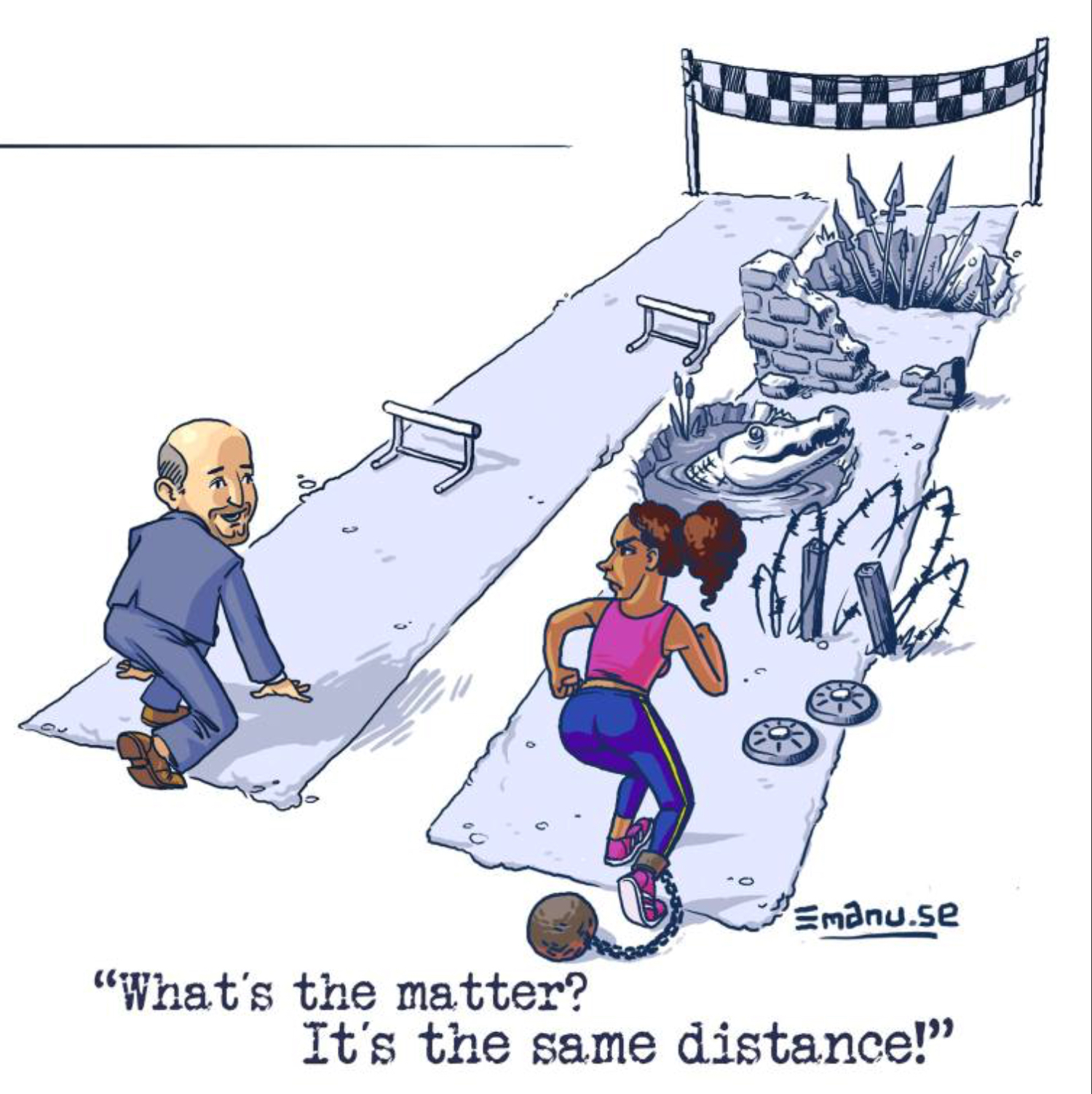
© Emanu

At what point would a police officer stopping a Black person not feel threatened? We know it isn’t when the Black person is unarmed. Certainly not when putting hands up and complying with policing orders. Not when the Black person is handcuffed and pinned to the ground. Not when the Black person is running away. Not even when it’s an unthreatening Black senior military officer in uniform. Not when a Black person is in their own home and reacting to an unauthorised entry by a police officer. There is clearly a problem with policing in America.  It’s not just the case of a few bad apples. The police approach policing Black people with the mindset of a farmer stalking a predatory animal on farmlands.

For those saying Daunte Wright wouldn’t have been shot if he wasn’t resisting arrest; even if that had saved him what about the next Black person killed while not resisting arrest? There is always another excuse or reason to use violence rather than de-escalate incidents involving Black people. The fact that the police are killing unarmed suspects is a sign this is about a lot more than just the high incidence of crime in Black neighbourhoods or armed criminals. There is a deeper issue here and it reflects something that is instilled, or at the very least reinforced during police training and induction. It is literally the standard response to a dispatch call involving Black people for the police to violently engage. 

The fact that the police believe that in all cases of deaths from an interaction with a Black person they are unlikely to be convicted, if ever charged has encouraged a ‘shoot first’ mentality. It almost doesn’t matter what the circumstances are there is almost always an assumption of justified killing. And in almost all cases this is backed up by the justice system. So now we have a situation where not only is police behaviour inherently illegal; there is almost no way of holding it to account through the justice system. In too many cases the District Attorney chooses not to prosecute. And where the cases go to court the jury rarely comes forth with a guilty verdict. 

It must be said that this a deeper reflection of the society we live in. One where White people still cross the road or clutch their valuables at the sight of a Black person. Depictions of Black people in the media still echo the stereotype of drug crazed criminal gangbanger from way back. It is no surprise that the percentage of Black people in prison far exceeds that of White people. It says something about why a higher proportion of Black people are subject to compulsory mental health orders. It is undeniable that health inequalities and deprivation are higher in Black neighbourhoods. And not due to a lack hard working individuals. 

It cannot be denied that we live in times where the police see Black people as dangerous threats, the justice system sees us as deserving of punishment, and the White majority see us as ill intentioned intruders. In the workplace employers do not want to promote career advancement for Black people.  In education Black students are routinely told to limit their aspirations. In business Black proprietors often find it difficult to break into mainstream markets. But strangely enough, society is content to see us excelling at singing and dancing; and running and jumping. So I guess things can’t be that bad.

With things being the way they are people will have to get used to Black people marching and agitating to make things better and get a fair shake. As long as we are here, and there have been no lack of effort put towards getting rid of us; there has to be a place for us. And we deserve the opportunity to make the place ours. We want to save the planet and protect endangered species but we also want to see Black Lives Matter.


Friday, 19 March 2021

Really Recognising Racism


If people really want to know what racism really is how about checking out the growing trend of whole swathes of people referencing Black Lives Matter whenever there is an issue with law enforcement or some criminal situation has become a topic of discussion. It is almost as if these people believe that because Black Lives Matter society has become a chaotic lawless dystopia. Or peep the fact that ever since the idea and movement that Black Lives Matter has entered the public consciousness all of a sudden people seem to be discovering all these other things that matter; as long as they aren’t Black lives. 

If we are absolutely determined to have our heart strings pulled at the evils of racism suffered by celebrities then we can easily reference Harry Belafonte, Spike Lee, Serena Williams, Colin Kaepernick, Ray Fisher, Gabrielle Union or Holly Robinson-Peete. These are people who have suffered from abuse, exclusion, blacklisting, objectification and loss of employment because of their race. Racism is no longer manifesting subversively or in dark corners of society. The KKK no longer need to wear hoods, except when they dress up for the annual Christmas party. There are many tales to tell to highlight the mental anguish racism is causing but I guess those interviews would be unlikely to net Harpo a $9m payday from the news networks.

Every person of colour has probably experienced racism in some general or unique way but it is not necessarily true that every experience of a person of colour is attributable to racism. We should be able to distinguish the experience of racism from other negative or damaging experiences that manifest as a standard, if largely unwelcome, part of the human life. While we need to be acutely aware of the inherently racist nature of western society and culture; we also need to watch out for instances where claims of racism is being used to further people's self interests.

There certainly is racism in Britain. The U.K. government’s “hostile environment” policy and the unjust deportation of ‘Windrush descendants’ has been a targeted effort to scapegoat and deprive Black people of their lawful rights and entitlements. Consider the way people of colour have been disproportionately affected by the covid-19 pandemic. In spite of the evidence pointing to the fact that as a result of deprivation, exclusion, poverty and health inequalities people of colour have been more at risk from infection and death by the virus the British government censored an official report into the impact of the pandemic on minorities and declared that race had no effect on infection or mortality. When it became clear that there was a higher incidence of infection in people of colour rather than mandate risk assessments for staff from minority ethnic groups the NHS management indicated that staff had to individually request for risk assessments themselves. Now that’s your illustration of institutional racism.

Every day we have cases of young Black people being racially profiled by the police. This has led to a disproportionate number of them being stopped and searched; and even killed while being arrested or in custody. Children of colour are being marginalised in the educational system all the time. Too many of them are being pushed towards unskilled employment, sports or show business and away from academics and highly skilled professions because they are not considered to have the aptitude for it by their teachers. British culture and institutions are inherently racist. You get a different level of care depending on which hospital, school or bank you go to. Inevitably access to these establishments is determined by status or wealth. This naturally excludes almost all people of colour. The value placed on circumstance of birth, ancestry and social title speaks to a society that seeks to perpetuate privilege and exclude those who are different, and thus less worthy.

Is the British royal family a racist institution? Absolutely, without a doubt. How can an entity built on the notion of birth being a basis for status and authority; and built on the back of imperialism, colonialism, oppression, murder and prejudice not be discriminatory? As long as it maintains its slavish adoption of birthright entitlement then it will remain racist. They may talk about fulfilling a duty of public service but public service should be a personal calling not something imposed autocratically by a select group of class determined elites. The royal family is also misogynistic, chauvinistic, anachronistic, privileged, entitled and semi-literate. But if you are going to marry into it then you need to draw a line in the sand and set out your terms for a dignified and free relationship before your nuptials. You can't expect to joyously sign on the dotted line then happily thrive in the warm embrace of a hateful legacy.

There is huge amount of work that needs to be done to address the issue of systemic racism in the UK. However, nothing in the recent discussions and exclamations does anything to get to the heart of the matter. And certainly time spent wishing the royal family integrates people of colour is wasted and unlikely to end in anything productive. Providing those people excluded with greater opportunities for education, fairness in employment, safe and secure living, reducing inequalities, tackling deprivation and avoiding poverty are where efforts need to be directed.

Tuesday, 29 September 2020

One Small Step for Equality, No Giant Leap for Black People

©Disney
The battle to overturn systemic racism and end police brutality is going to be the fight of all our lives. Just having the world wake up to the real issue of racist oppression and the havoc it has, and is wreaking on Black people is a major win. However, it is not the only battleground we have to show up at, and fight hard to make  gains on. Whatever gains we make in overthrowing the oppressive system cannot be consolidated unless we Black people actually uplift and enlighten ourselves. If we don’t become better as individuals, and a people then it will all be for nothing.

How many Black people have felt stigmatised in their communities for focusing on their education, careers or health? It is typical for Black people dismiss other Black people as squares or wannabes for wanting to get an education. Building a career and getting a regular office job is often considered selling out. Adopting a healthy lifestyle for anything other than aesthetics is seen as just an incomprehensibly lame thing to do.

During this covid-19 pandemic Black people have not always shown the best judgement or awareness of personal or public safety. And this is despite the fact that we have been one of the groups most vulnerable to infection and serious illness. Too often Black people have been some of the first to show up at illegal raves, and some of the last to socially distance or wear a face covering. We need to understand the difference between being a smartass and actually being smart. The reckless behaviour has not been atypical of the behaviour of a lot of Britons; who have preferred to wear their masks on their chins, off their noses, on their necks, over an eye, on their belts, and in their hands. But Black people cant afford to just follow the prevailing wind. They need to know when to be better. 

We need more people in families and the local communities to be role models to the rest of our people. It is fine to admire celebrities and the wealthy but their lives do not reflect the reality most of us have to contend with. We need people to set the right examples in getting the most from education, how to work hard, being responsible, and giving back to the community. People can lose their way or fall foul of the law and become rehabilitated. We want to be able to laud them for their resilience and redemption rather than hold them in thrall as outlaws or rebels. We can’t afford to give up on ourselves. 

Good parenting needs to be restored to it’s rightful place; front and centre of the Black community. Whatever the make up of the family, the upbringing of children must be given the priority it needs. That isn’t to say that it will be easy or without considerable challenges but it is central to how we as Black people make a better future for ourselves. In order to be better parents and role models to young people Black people need to reflect on what their values are; and how they deal with the personal and social challenges facing them. If people cannot show resilience and fortitude then it is unlikely they will inspire the youth to walk a path of integrity and selfless service. 

The hope we have is that we as a people enlighten ourselves and find the strength to stand tall in the face of inequality and oppression. In making better choices we can encourage the youth to become aspirational and personally fulfilled. The danger we face isn’t missing our way but in never having a better path to follow. 

Monday, 31 August 2020

Troublingly Different

We can be of different gender, race, sexuality, ethnicity, faith, ideology, ability and yet still find things to unite us. We all want love, safety, security, health, shelter, and the best for those we care about. We have no right to deprive anyone of any of these things; and no one should feel entitled to deprive us of it. Unfortunately, individual mindsets and society itself are being conditioned to believe inequality is the just dessert of the underclass.

There are so many contradictions in modern day American society; and too few Americans are doing enough to confront them. America wants to be strong but it can’t abide the idea of free or universal healthcare. America wants to be wealthy but it continues to sow the seeds of disunity and conflict across its communities. America wants to be safe but it holds fast to the idea that unfettered access to guns is at the heart of being American.

Law enforcement in America claims that its many killings and shootings of Black people is in response to the threat they pose, and are perceived to pose to law enforcement officers. However, the one thing that would drastically reduce that threat would be gun control. There is no doubt that a reduction of personal gun ownership would significantly reduce the cases of law enforcement officers being confronted by armed assailants. Unfortunately, history has shown that this would probably not equivalently result in a reduction of police brutality on Black people. The incidence of unarmed Black people being violently confronted or killed by the police speaks for itself.

Since after World War 2 when people from Africa and the Caribbean were ushered into Britain to help with the rebuilding of the shattered nation; they have been confronted with being told to go back to where they came from. This is still a common occurrence across the United Kingdom. There is a core of British people who just hate the presence of foreigners. They just won’t ever be British enough for them. There is another section of society that sees diversity as a threat. They continue to stereotype people of colour even when the objects of their vitriol were born in the UK and are actually British citizens.

Prejudice and discrimination are learned traits. As much as individuals and groups are the perpetrators of the rough and harsh justice being dealt out to minorities; it is society and its institutions that have normalised and reinforced the oppression that minorities have had to endure and live with. There has to be some recognition that there will be no real change in people until social institutions themselves are reconditioned. Any calls to defund the police, reform education, restructure healthcare, refocus the justice system, or address institutional racism are not about shutting down the institutions. Rather it’s about redirecting policy and retraining organisations to better meet the needs of a changing society. Improvements are needed and it will take a lot of work to make them happen. However, everyone will need to trouble themselves to make the difference that is needed for things to get better for all people. I believe this is what the late John Lewis, the American civil rights pioneer called; making “good trouble”.

Monday, 8 June 2020

Time to Push Back

Prejudice and discrimination are pernicious. It doesn’t matter who is doing it, or where it’s happening. Whether it’s the UK, USA, Rwanda, Libya, Saudi Arabia, Israel, China, Brazil, Australia or Canada. The damage that centuries of oppression has done to people of colour is generational. What that means is that when things come to a boil a bloody battle is bound to ensue. The establishment is going to fight to maintain the status quo and Black people will need to fight back just as hard for change. The likelihood of these clashes causing chaos and becoming violent is high. Nobody is trying to tear down their own neighbourhoods but change is a unstoppable force and prejudice and privilege want to be an immovable object. And therefore a cataclysmic reaction must result.

The fact that there has been violence at protests has not subverted or distracted from the mission to tackle and push back on systemic racism and brutality by the establishment. There is a clear imperative to highlight oppression and discrimination while calling for action to end it and mitigate its impact. As much as people need to be safe during protest the time to be passive is past.

These protests are not about taking over. They are about taking a seat at the table. A seat that has long been denied us. Too many people who have been let in have failed to represent the interests of minorities robustly. People have compromised and conceded ground to institutional discrimination. Being a minority means that democratic processes too often fail to provide a platform to combat discrimination and inequality.

We are not safe in our homes. We are not safe on the streets. We are not safe at work. We are no longer prepared to silently object while we are being viciously and systematically oppressed and brutalised.

There are inequalities for us to rise up against and fight to overcome. We want justice but we also have needs.
  • We want law enforcement to ban all procedures that allow the use of violence against unarmed and unresisting Black peoples.
  • We want all deaths in police custody or by police actions to be be reported and investigated independently. 
  • We want to be able to live and work in any community without being stigmatised and harassed. 
  • We want the ability to bring diversity into a workplace to be recognised as a special skill and competence. 
  • We want public and corporate policies to be subject to equality impact assessments. 
  • We want disadvantaged minorities to have access to state funded education and primary healthcare. That is why we vote. If other people don’t want it then that’s their problem. 
  • We want the establishment and organisations to stop agreeing that Black Lives Matter, and start proving it. 
We don’t want to have to run or hide. We just want to live and thrive. 

Thursday, 31 October 2019

BREXIT Black & Blue

The current mess that is Brexit has proven clearly that politicians are mostly inclined to pursue their self and partisan interests ahead of the greater good. As a Black citizen of the United Kingdom life after Brexit is threatening to be both frightening and frustrating. The government is full of fools and frauds with very little moral standing. The opposition is full of dogmatic ideologues and short sighted political plodders. Brexit presents a range of social and economic problems for all people on the British isles, however there are likely to be a number of issues specific to Black and Minority Ethnic people. There has been an alarming rise in right wing nationalism and general xenophobia across Europe in recent times. This does not bode well for conditions that await Black people in the new order of things.

Travel around Europe will potentially become increasingly fraught for Black British citizens. Not only will they have to go through tough visa application processes but they are likely to be subjected to further scrutiny at point of entry. It isn’t a certainty that there will be prejudice in the process post Brexit but the current experience of Black non EU migrants and visitors suggests there is scope for discrimination.

Access to support or services while abroad will be variable. Since there won’t be a guarantee of entitlement officials’ prejudices will play a role in how Black people are treated in the event of an emergency or crisis.

An important contribution to quality of life for Black people living abroad is having family, relatives and friends visit them. Similarly being able to travel freely to visit loved ones is important. Maintaining those intimate connections with people living in the EU will become much harder. The likelihood is that

It is traditionally difficult for relatives outside the EU to get visas to visit the UK, and now it is going to be harder for relatives in the UK to get visas too. Ultimately this will affect a range of situations from family interaction to spouses being able to join their partners.

Almost all of Europe is likely to suffer adversely from Brexit but there is the potential that a heightened level of discrimination towards Black people might be one of the unintended consequences. This is something that the EU and UK should put formal processes in place to monitor and tackle as necessary.

Wednesday, 21 August 2019

Sports and Prejudice

Does the fact that a person is an athlete or sporting personality mean that any observations about their performance or behaviour should be exempt from accusations of racism or prejudice? It seems that on too many occasions criticisms of ethnic minority and female athletes seems to flirt with prejudice, or is actually outright discriminatory. While social media has provided a new platform for prejudicial abuse there is no shortage of such abuse being levelled in person or amongst groups at sporting events. Fans should be free to criticise and ridicule while analysts should be able to critically appraise performance. However, this should be without being racist or misogynistic.

A lot of racial inferences were made about Serena Williams’ questionable behaviour during the 2017 US Open Tennis final. A certain Australian cartoon was particularly offensive. Following a series of racist incidents at football matches in England ex England international John Barnes made reference to unconscious prejudice; and stated that racism in society as a whole needs to be tackled first in order to get to grips with racism in football. Tammy Abraham, the Chelsea FC striker, missed a penalty in the UEFA Super Cup final and was subjected to racist abuse online. The racially charged atmosphere in most sporting venues, the paucity of Black and Minority Ethnic people in management positions, the chauvinism directed at female officials and lack of effective action against offenders appears to be encouraging more bigots to unleash their bile in sporting settings.

The issue of equal pay continues to dog sports. At sporting events where females and males compete alongside each other there is no reason not to pay them equally. Lawn Tennis has made some strides in this direction. In America, women’s soccer is certainly the more successful on the international stage. There is also more female participation in soccer at grassroots levels. The demand for equitable remuneration appears to be both fair and reasonable, at the very least. It appears moves towards a balanced discussion about equal pay are held back by the greater number of males administering sports and an adherence to arcane and outdated traditions.

It seems that sports still remains a space in which people feel it’s ok to give vent to whatever racist or sexist vitriol they have pent up inside them. The idea that this is mainly due to unconscious prejudice would imply that these bigots are merely being naive rather than ignorant. However, the vitriol and violence that often accompanies such prejudice suggests that it is a consciously held view that seeks to dehumanise its victims.

While it is true that sports can not eradicate prejudice in society at large, sporting bodies certainly have a responsibility to combat prejudice and promote anti-discrimination in their areas. This includes defending and supporting victims, challenging media and online prejudice against their wards, excluding perpetrators and those who condone discrimination directly or by silence and inaction.

A self aware organisation would ideally welcome activism amongst its members. Socially responsible  values not only encourage commercial value; they also promote inclusion and participation. This is the real way to increase engagement in a sport. However, as we have seen with the NFL in America not all organisations have that level of maturity or self awareness. It must be said though, that combating prejudice and discrimination in sport is a different duty to promoting socially positive values. Dealing with prejudice should be a fundamental part of every sports’ charter. It should not be optional or done at their convenience.

Tuesday, 18 June 2019

Caster Semenya: The Case Against the IAAF

The CAS rejected Caster Semenya’s appeal against a new IAAF regulation requiring competitors in the 400 and 800 meters disciplines to take medication to regulate their testosterone levels if they are classified as having hyperandrogenism. The ruling found that the regulation was reasonable and fair to protect the integrity of competition. When news of CAS’ ruling originally broke I instantly disagreed with it, considering it to not properly understand the nature of discrimination. My view was that if a person was legally recognised as a woman then no professional organisation had a right to limit their right to participate in any activities as a woman. However, I then read some material about the biological and physiological nature of the XY condition and felt I needed to give the matter more thought. I needed to explore whether the condition was a natural physical one or actually altered their gender at a more subliminal level.

CAS’ decision to include testosterone levels as a criterion in the definition of a woman feels fundamentally flawed. Testosterone is a naturally occurring hormone in human beings whose levels the individual cannot naturally alter. Therefore it isn’t within the individual’s purview to choose what level occurs in them. This would make it naturally occurring and reasonably permissible, as long as there has been no manual ingestion or physical manipulation. The definition fails to make a distinction between what is normal and what is natural. While the condition that has resulted in the higher levels of testosterone is not the norm amongst women it is perfectly naturally occurring in the women with the condition. They therefore should not be penalised or stigmatised because of it. To not  allow them to participate professionally would be unfair and directly discriminatory. Being exceptional is not an unusual thing in sports. Be it height, coordination, reflexes, speed, physicality; the history of sport is defined by individuals with exceptional characteristics.

The CAS ruling stipulated that any discrimination involved in the IAAF decision was reasonable and necessary to ensure the integrity of the sport. That doesn’t actually compute. The standard for performance in athletics is on a continuum between qualifying cut off and world record. The participation of these athletes has not prevented anyone from qualifying for an event. To the best of my knowledge none of the women with the targeted condition has broken a world record or actually been close to doing so. It would therefore stand to reason that if he world record was set by women with ‘normal’ levels of testosterone then they would not have been disadvantaged by the participation of the athletes currently being targeted. So it would appear that these athletes are being penalised because the rest of the current field are not able to perform to a higher level. This in effect saying that because the current crop aren’t good enough to beat these athletes then it can’t be fair.

It appears from the actions taken by the IAAF that it considers testosterone levels to be the single or overwhelming factor responsible for the performance of the female athletes with the condition. It isn’t clear what evidence it has to that effect. Certainly, there are other women with that condition who are not excelling over those distances in athletics. In fact, for all we know there might be women out whose athleticism is hindered by the condition. The IAAF decision suggests any woman with the condition would automatically have an unfair advantage over those distances. We do not know that is true to any degree. The women who are doing well have trained, applied themselves and developed skills to enable them to excel. That presumably doesn’t just come with higher testosterone levels.

Doriane Coleman wrote an article declaring the CAS ruling a victory for female athletes. Her position was that these women were to all intents and purposes male and their participation would deny ‘females’ the chance to win in competition. Her implication that these athletes are unbeatable is clearly erroneous. They have been beaten and would be beaten anyone running close to a world record. And the suggestion that if other athletes are not winning then it devalues the competition is just nonsense. When Ed Moses was on his winning streak he was lauded for it. And I thought the spirit of sport was in the dignity of competing and giving it your all. It shouldn’t be just about winning.

The IAAF requiring athletes to take medication to lower their testosterone levels is not only unfair but also unreasonable. Does it know what impact this might have on their personal and sporting lives? Denying them the opportunity to participate professionally unless they take medication is not too dissimilar to an employer refusing a woman a job unless she agrees to take contraception to avoid getting pregnant during the period of employment.

The IAAF has a duty of care to all athletes and is responsible for the regulation of the sport. However, it should not risk the health and wellbeing of a minority group of athletes to appease the sensitivities of a larger majority. There is no way that these athletes are destroying the integrity of the sport and they should not be subject to unverified medical procedures to satisfy some people’s notion of normality. In so much as this ruling appears to target a select group and seeks to prevent them from participation then it is unfair and discriminatory. Sport should never be about curtailing natural ability.

Wednesday, 20 February 2019

London Policing Twenty Years on from the Macpherson Report

It has been twenty years since the Macpherson Report into the London Metropolitan Police handling of the racist murder of Stephen Lawrence. Doreen Lawrence, Stephen's mother' has suggested that gains in the aftermath of the Macpherson Inquiry report have not been built upon. However, Cressida Dick, the Commissioner of the Metropolitan Police, claims that the Met has made great progress and come a long way.

Since the Macpherson Inquiry there has been the Tottenham Riots in 2011 following the police shooting to death of Mark Duggan. The riots subsequently spread to the rest of London and nationwide. There was the shooting of Azelle Rodney in 2005. Rodney was shot to death by a police marksman while in a car with two associates. An inquiry later found the shooting unlawful. There was the shooting to death of John Charles de Menezes in 2005 following the July 7 terror attack. He was shot in a case of mistaken identity and the Commissioner of the Metropolitan Police was later found guilty and fined for a failure of duty of care. In 2008 Sean Rigg died in police custody as a result of being restrained by police officers. Olaseni Lewis died on a mental health ward following prolonged restraint by police officers. Dalian Atkinson, an ex England international footballer, died in 2016 after being tasered by police officers whilst in mental health crisis. In 2017 Edson da Costa died after he subdued by CS gas following a car stop by police. In 2017 Rashan Charles died after being restrained by a police officer who suspected him of swallowing a contraband substance.

In 2017/2018 twenty three people died in police custody or following police interventions. This was the highest figure recorded in ten years.

In the consideration of where the Metropolitan Police is twenty years after Macpherson there has been a lot of talk about how much the proportion of officers from minority ethnic groups has increased (from 3% to 14%). There has also been mention of race awareness and community engagement training being carried out. The suggestion is that it is now a different police force. However, is it a better police force in regards to its strategic approach to police minorities, or managing minority police officers?

It is possible that structures and image awareness in the Met has changed but have attitudes moved on all that much? People from minority groups are still having negative experiences of policing in London on a daily basis. And a lot of police officers still see Black people as threatening, and likely to offend. Senior police officers are less likely to show any confidence or offer insightful guidance when dealing with cases involving people from minority ethnic groups. It is unclear whether the progression of minority ethnic officers in the force has significantly improved; or whether minority ethnic officers generally feel well supported, free from prejudice, and empowered in their jobs.

While some things have changed since Macpherson it is clear that the Metropolitan Police really cannot beat its chest about how well it has done in managing issues of race in minority ethnic communities or police officers. There is in no doubt that it could do more and do better. The real issue is how much does the Met itself know that that is the case.


Thursday, 21 September 2017

A Failing Association

Football across the British Isles is a bonding experience for children and adults of all ethnicities and genders. People grow up playing, watching and enjoying the game. And while it is true that it has become a lucrative form of employment for professionals; it is also a unifying experience for many supporters and amateur players out there. It is because of this that the Football Association has a responsibility to set standards for both the performance and administration of the game. In recent times however, the FA has struggled to demonstrate any moral responsibility for the well-being of the game or its minority group players.

The FA investigation into charges of bullying and discrimination in the case of Eniola Aluko and Lianne Sanderson fell very short of any standard of fairness and thoroughness. The barrister appointed to lead the investigation appeared to not have a lot of understanding of the nuances of racism and discrimination. It was right that she should have looked for evidence of the claims made. However, in cases of racism there is a need to also explore attitudes and the environment in which the alleged incidents occurred. In basing her findings solely on the conclusion that there wasn’t any overriding proof she made little effort to actually even explore what the experience of the alleged victim of discrimination was. This showed a lack of sensitivity and an ignorance of the social context of racism.

It is ludicrous that a second investigation should have actually concluded with a decision after Eniola Aluko declined to cooperate with it. While her non cooperation was far from ideal, without it any findings could hardly have been credible. The investigation didn’t question Mark Sampson as to why he had made earlier self admitted remarks about Ebola. It also seems strange that Mark Sampson was cleared without the investigation actually giving Lianne Sanderson a hearing in person. It was almost as if her claims had already been deemed unsubstantial. This is in addition to no effort being made to interview Drew Spence about prejudicial comments made to her in the presence of some other England players.

The FA should have realised the Eniola Aluko being dropped from the England squad following her complaint would give the appearance of victimisation. There should have been more effort taken to explain the reason for her exclusion to her in person. This would have given her a forum to express her feelings about it. The FA then paying up her contract and paying a further sum for a non disclosure agreement certainly seems like an effort to quash rather than resolve the issue.

While Mark Sampson’s eventual sacking as England Women’s Football Manager is claimed to be unrelated to the allegations of bullying and discrimination it does raise significant questions. The incidents at Bristol Academy clearly show that he was not a person of unimpeachable character. It also further demonstrates that the FA and its coterie of advisors are barely competent or capable of simple good judgement. The FA claiming that the incidents in Bristol showed no safeguarding risks seems to fly in the face of adult protection requirements and standards. There may not been any child protection concerns but multiple adult protection concerns should have been flagged immediately.

The FA is an organisation that makes a big show of publicly espousing social responsibility. However, in its operations it doesn’t demonstrate much social awareness or much of a social conscience. Almost every opportunity it has to act with integrity and address traditional and institutional bias falls woefully short. There is so much focus on being seen to be doing the right thing that there isn’t much capacity to actually understand what is right and act appropriately so. Providing a platform for the young to thrive in the game and for players to be supported and protected, where necessary, should be one of the first principles of the organisation. Unfortunately, that seems to be what comes last in consideration if you work for the Football Association.