Showing posts with label institutional racism. Show all posts

Thursday, 3 November 2022

The business of race


Of recent Kanye West has been talking out of his ass and stirring up a lot of controversy with threatening and offensive pronouncements about Jews. A lot of his behaviour and what he has been saying has strong hints of clinical paranoia. People have turned on him in droves and he has not made much of an effort to make amends or row back his comments. Multiple businesses and organisations have ended relationships with him in response to the public outcry. He is clearly being hit in the pocket by the reactions to his unconscionable utterances but his reputation is taking an even bigger battering. It remains to be seen if there is any way back for him from casting out that he is currently going through. 

Kanye has been accused of stirring up anti-semitism and giving license to fascists and nazis to show off their bigotry. This might be a bit of a reach because fascists have never needed any encouragement to abuse or attack Jews. While fascists might wholeheartedly agree with Kanye it would appear he is actually getting more obvious and vocal support from Republicans. Republicans have literally hoisted Kanye on their shoulders and showed him around as their gladiator in their war against “wokeness”. While the mainstream is working overtime to cancel Kanye the Republicans are promoting him for all they’re worth. 

Kanye West is currently topping the unpopularity charts but he has an extensive back catalogue of bigoted declarations dismissing the suffering of Black people and criticising the response to historic abuses, and icons in the civil rights struggle. He also routinely mistreats and verbally abuses Black people and women he comes across. It is interesting that even when he was at his most obnoxious he did not receive the wholesale disapproval he is currently experiencing. In fact, businesses were falling over themselves to throw money at him for his questionable creative endeavours. Whether you call him a maverick or a moron businesses had no problem making money off him while Black people and women were the targets of his unsavoury sayings. 

It is only too right that Kanye West is facing censure for his anti-semitism. His behaviour thoughtless and feeds into harmful stereotypes of Jews. However, it is problematic that society in general is a lot more tolerant of prejudice when it is directed at other minorities. We have seen mainstream right wing personalities and politicians try to downplay the murder of George Floyd and the GOP in America have launched an all out onslaught on Critical Race Theory. A lot of the right wing outrage is a concerted effort to deny the reality of prejudice and discrimination suffered by Black people in America. A lot more could be done to address racial inequality and tensions but they would rather put all that effort into covering it up. 

The U.K.’s prime minister’s office recently released a statement saying that Rishi Sunak; the prime minister, does not consider the U.K. a racist country. While it is true that not all people are racist certain groups definitely are and the institutions still show evidence of systemic racism. Health inequalities, disproportionate involvement in criminal justice system, the ‘Windrush Scandal’, and the current animosity towards Critical Race Theory are strong indications of that. These are permitted to persist because the environment we’re in allows it. There is such a strong undercurrent of prejudice towards Black people that many cases of subtle or overt racism towards Black people barely cause a ripple. The business community has figured out that they are better off covering up or just ignoring the issue. Maybe this was what Kanye was hoping for when he decided to give vent to his inner voice. 

Thursday, 15 July 2021

Fighting Racism Matters


The experience of being discriminated against and abused because of your race in societies that you have been born into and grown up in is unique to people of colour. The longstanding nature of racial discrimination has meant that it has become innate and systemic in most western societies. This doesn’t deny the efforts of some groups to combat and make amends for it. However, it is counterproductive to continue to argue that the existence of systemic racism is not an issue. It means that the history of racial prejudice and discrimination is not taught comprehensively in communities or schools, and it poses a real danger to people of colour and social cohesion. 

As Black people and persons of colour we are not a homogeneous group. This is despite a lot of individuals from majority populations not being able to tell people of colour apart. Whether we are Asian, from the Pacific Islands or African, including by birth or heritage we are all very different people. In fact people from any two different African countries are very likely to be nothing alike and have little in common. However despite all these differences our experience of racism, prejudice and discrimination remains singularly uniiform. If you take a look at America any group of persons of colour may differ in culture, norms or perspectives but will still face the absolute same experience when it comes to discrimination. In fact if a being from outer space landed in America today it is most likely to be more welcomed than a hard working, well spoken and educated person of colour. 

People of colour need to go on a journey of self development that means they are able to support themselves and give back to their communities. We need older people to do more to promote socially aware values that espouse empowerment and self awareness. Young people need to feel inspired to develop themselves and adopt lifestyles that allow them to be independent and enlightened. We cannot wait for reparations before we recognise and repair the rifts in our own communities. Even reparations will not initiate the empowerment and solidarity that people of colour need to uplift their communities in majority White societies. The discussion of reparations might trigger some opportunities to highlight the challenges of striving for racial equality. However, right wing governments and politicians are extremely ready to vigorously deny the space to even have the discussion in a public arena. Any attempt to raise and pursue the issue of historical and systemic racism is seen as a threat rather than an opportunity to work towards a better understanding of the needs and challenges of minority communities. 

The recent racial criticism and abuse of English footballers who participated in the 2021 European Football Championship says a lot for how racial intolerance is very much alive in high society and underbelly of the nation. There might have been any number of players who underperformed during the tournament but it was the Black players who were particularly singled out for abuse. It made no difference that the Black players had represented their country with pride and distinction. The sort of racism they have been subjected to is not isolated or a rare occurrence. It is the sort of prejudice that people of colour experience on the streets, in school, in the workplace and during interactions with public institutions. This speaks to a level of institutionalised racism that needs to be acknowledged in order to be addressed. 

Tuesday, 25 May 2021

The View from the Top

© Guardian 

The U.K. government’s commission on race equality produced a report that concluded that institutional racism was no longer a thing in Britain, and Britain is an exemplar nation for race equality and integration.  It should probably be enough to delve into the membership of the commission to roundly discredit its findings and its situational blindness. However, this is not the season for picking low lying fruit. Let’s take a good look at the world according to this group of astute social historians. 

The report asserts that people from minority ethnic groups have an equal chance of success as long as they work hard. Note that it says equal rather than greater chance. This clearly takes no account of generational wealth. It does however, play up to the racist trope that as long as they keep their heads down and do as they are told people of colour will do just fine. The nature of the British honours system serves to further to entrench inequality and exclusion amongst minorities. Titles bestow status and access on holders and these are mostly passed on to cronies and cohorts of the majority White political establishment.

Unfortunately, the reverie about the sweet life minorities are living in the U.K. is broken by studies showing that Black youths are three times as likely to be unemployed than their White compatriots, and the grieving mother of a lost Black boy whose mother has complained that her initial reports of him being missing were not taken seriously by the police before he was found dead. The Windrush scandal still blights the lives of Black Britons.

There are some simple truths that have to be faced no matter what perspective one chooses to look at institutional racism from. In 2021 people of colour are still facing discrimination and violence at the hands of institutions and individuals. The legacy of racism in this country has generational reverberations through Black communities. It has created communities steeped in poverty and deprivation. A consequence of this has been that in some communities of colour people have internalised the racism they have endured. Some people do not see themselves as being able to succeed, or even survive, just by following the rules. So we have low achievement in education, and often a derisory attitude towards regular employment.

Great Britain has not solved the problem that is racism; and it really doesn't have cause to pat itself on the back. There is still a lot to be done, and a lot of people suffering on the margins of society. There is a place for people of colour in the UK and they have made, and continue to make, tremendous contributions to their communities and society as a whole. However, if your knee is on my neck it would be impossible for you to see or recognise my pain and suffering.

Wednesday, 28 April 2021

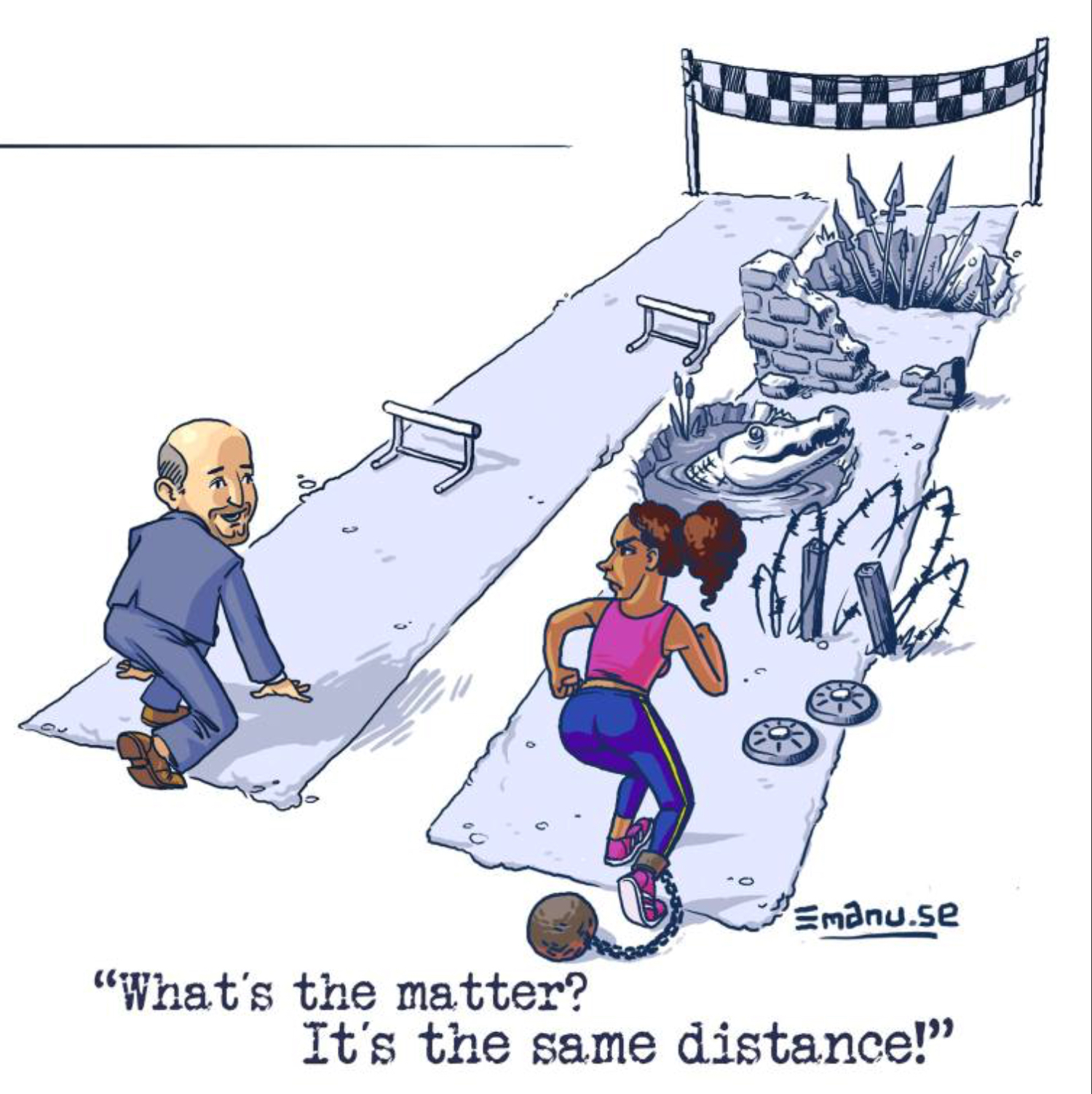
Society versus Black People

© Emanu

At what point would a police officer stopping a Black person not feel threatened? We know it isn’t when the Black person is unarmed. Certainly not when putting hands up and complying with policing orders. Not when the Black person is handcuffed and pinned to the ground. Not when the Black person is running away. Not even when it’s an unthreatening Black senior military officer in uniform. Not when a Black person is in their own home and reacting to an unauthorised entry by a police officer. There is clearly a problem with policing in America.  It’s not just the case of a few bad apples. The police approach policing Black people with the mindset of a farmer stalking a predatory animal on farmlands.

For those saying Daunte Wright wouldn’t have been shot if he wasn’t resisting arrest; even if that had saved him what about the next Black person killed while not resisting arrest? There is always another excuse or reason to use violence rather than de-escalate incidents involving Black people. The fact that the police are killing unarmed suspects is a sign this is about a lot more than just the high incidence of crime in Black neighbourhoods or armed criminals. There is a deeper issue here and it reflects something that is instilled, or at the very least reinforced during police training and induction. It is literally the standard response to a dispatch call involving Black people for the police to violently engage. 

The fact that the police believe that in all cases of deaths from an interaction with a Black person they are unlikely to be convicted, if ever charged has encouraged a ‘shoot first’ mentality. It almost doesn’t matter what the circumstances are there is almost always an assumption of justified killing. And in almost all cases this is backed up by the justice system. So now we have a situation where not only is police behaviour inherently illegal; there is almost no way of holding it to account through the justice system. In too many cases the District Attorney chooses not to prosecute. And where the cases go to court the jury rarely comes forth with a guilty verdict. 

It must be said that this a deeper reflection of the society we live in. One where White people still cross the road or clutch their valuables at the sight of a Black person. Depictions of Black people in the media still echo the stereotype of drug crazed criminal gangbanger from way back. It is no surprise that the percentage of Black people in prison far exceeds that of White people. It says something about why a higher proportion of Black people are subject to compulsory mental health orders. It is undeniable that health inequalities and deprivation are higher in Black neighbourhoods. And not due to a lack hard working individuals. 

It cannot be denied that we live in times where the police see Black people as dangerous threats, the justice system sees us as deserving of punishment, and the White majority see us as ill intentioned intruders. In the workplace employers do not want to promote career advancement for Black people.  In education Black students are routinely told to limit their aspirations. In business Black proprietors often find it difficult to break into mainstream markets. But strangely enough, society is content to see us excelling at singing and dancing; and running and jumping. So I guess things can’t be that bad.

With things being the way they are people will have to get used to Black people marching and agitating to make things better and get a fair shake. As long as we are here, and there have been no lack of effort put towards getting rid of us; there has to be a place for us. And we deserve the opportunity to make the place ours. We want to save the planet and protect endangered species but we also want to see Black Lives Matter.


Friday, 19 March 2021

Really Recognising Racism


If people really want to know what racism really is how about checking out the growing trend of whole swathes of people referencing Black Lives Matter whenever there is an issue with law enforcement or some criminal situation has become a topic of discussion. It is almost as if these people believe that because Black Lives Matter society has become a chaotic lawless dystopia. Or peep the fact that ever since the idea and movement that Black Lives Matter has entered the public consciousness all of a sudden people seem to be discovering all these other things that matter; as long as they aren’t Black lives. 

If we are absolutely determined to have our heart strings pulled at the evils of racism suffered by celebrities then we can easily reference Harry Belafonte, Spike Lee, Serena Williams, Colin Kaepernick, Ray Fisher, Gabrielle Union or Holly Robinson-Peete. These are people who have suffered from abuse, exclusion, blacklisting, objectification and loss of employment because of their race. Racism is no longer manifesting subversively or in dark corners of society. The KKK no longer need to wear hoods, except when they dress up for the annual Christmas party. There are many tales to tell to highlight the mental anguish racism is causing but I guess those interviews would be unlikely to net Harpo a $9m payday from the news networks.

Every person of colour has probably experienced racism in some general or unique way but it is not necessarily true that every experience of a person of colour is attributable to racism. We should be able to distinguish the experience of racism from other negative or damaging experiences that manifest as a standard, if largely unwelcome, part of the human life. While we need to be acutely aware of the inherently racist nature of western society and culture; we also need to watch out for instances where claims of racism is being used to further people's self interests.

There certainly is racism in Britain. The U.K. government’s “hostile environment” policy and the unjust deportation of ‘Windrush descendants’ has been a targeted effort to scapegoat and deprive Black people of their lawful rights and entitlements. Consider the way people of colour have been disproportionately affected by the covid-19 pandemic. In spite of the evidence pointing to the fact that as a result of deprivation, exclusion, poverty and health inequalities people of colour have been more at risk from infection and death by the virus the British government censored an official report into the impact of the pandemic on minorities and declared that race had no effect on infection or mortality. When it became clear that there was a higher incidence of infection in people of colour rather than mandate risk assessments for staff from minority ethnic groups the NHS management indicated that staff had to individually request for risk assessments themselves. Now that’s your illustration of institutional racism.

Every day we have cases of young Black people being racially profiled by the police. This has led to a disproportionate number of them being stopped and searched; and even killed while being arrested or in custody. Children of colour are being marginalised in the educational system all the time. Too many of them are being pushed towards unskilled employment, sports or show business and away from academics and highly skilled professions because they are not considered to have the aptitude for it by their teachers. British culture and institutions are inherently racist. You get a different level of care depending on which hospital, school or bank you go to. Inevitably access to these establishments is determined by status or wealth. This naturally excludes almost all people of colour. The value placed on circumstance of birth, ancestry and social title speaks to a society that seeks to perpetuate privilege and exclude those who are different, and thus less worthy.

Is the British royal family a racist institution? Absolutely, without a doubt. How can an entity built on the notion of birth being a basis for status and authority; and built on the back of imperialism, colonialism, oppression, murder and prejudice not be discriminatory? As long as it maintains its slavish adoption of birthright entitlement then it will remain racist. They may talk about fulfilling a duty of public service but public service should be a personal calling not something imposed autocratically by a select group of class determined elites. The royal family is also misogynistic, chauvinistic, anachronistic, privileged, entitled and semi-literate. But if you are going to marry into it then you need to draw a line in the sand and set out your terms for a dignified and free relationship before your nuptials. You can't expect to joyously sign on the dotted line then happily thrive in the warm embrace of a hateful legacy.

There is huge amount of work that needs to be done to address the issue of systemic racism in the UK. However, nothing in the recent discussions and exclamations does anything to get to the heart of the matter. And certainly time spent wishing the royal family integrates people of colour is wasted and unlikely to end in anything productive. Providing those people excluded with greater opportunities for education, fairness in employment, safe and secure living, reducing inequalities, tackling deprivation and avoiding poverty are where efforts need to be directed.

Monday, 31 August 2020

Troublingly Different

We can be of different gender, race, sexuality, ethnicity, faith, ideology, ability and yet still find things to unite us. We all want love, safety, security, health, shelter, and the best for those we care about. We have no right to deprive anyone of any of these things; and no one should feel entitled to deprive us of it. Unfortunately, individual mindsets and society itself are being conditioned to believe inequality is the just dessert of the underclass.

There are so many contradictions in modern day American society; and too few Americans are doing enough to confront them. America wants to be strong but it can’t abide the idea of free or universal healthcare. America wants to be wealthy but it continues to sow the seeds of disunity and conflict across its communities. America wants to be safe but it holds fast to the idea that unfettered access to guns is at the heart of being American.

Law enforcement in America claims that its many killings and shootings of Black people is in response to the threat they pose, and are perceived to pose to law enforcement officers. However, the one thing that would drastically reduce that threat would be gun control. There is no doubt that a reduction of personal gun ownership would significantly reduce the cases of law enforcement officers being confronted by armed assailants. Unfortunately, history has shown that this would probably not equivalently result in a reduction of police brutality on Black people. The incidence of unarmed Black people being violently confronted or killed by the police speaks for itself.

Since after World War 2 when people from Africa and the Caribbean were ushered into Britain to help with the rebuilding of the shattered nation; they have been confronted with being told to go back to where they came from. This is still a common occurrence across the United Kingdom. There is a core of British people who just hate the presence of foreigners. They just won’t ever be British enough for them. There is another section of society that sees diversity as a threat. They continue to stereotype people of colour even when the objects of their vitriol were born in the UK and are actually British citizens.

Prejudice and discrimination are learned traits. As much as individuals and groups are the perpetrators of the rough and harsh justice being dealt out to minorities; it is society and its institutions that have normalised and reinforced the oppression that minorities have had to endure and live with. There has to be some recognition that there will be no real change in people until social institutions themselves are reconditioned. Any calls to defund the police, reform education, restructure healthcare, refocus the justice system, or address institutional racism are not about shutting down the institutions. Rather it’s about redirecting policy and retraining organisations to better meet the needs of a changing society. Improvements are needed and it will take a lot of work to make them happen. However, everyone will need to trouble themselves to make the difference that is needed for things to get better for all people. I believe this is what the late John Lewis, the American civil rights pioneer called; making “good trouble”.

Wednesday, 20 February 2019

London Policing Twenty Years on from the Macpherson Report

It has been twenty years since the Macpherson Report into the London Metropolitan Police handling of the racist murder of Stephen Lawrence. Doreen Lawrence, Stephen's mother' has suggested that gains in the aftermath of the Macpherson Inquiry report have not been built upon. However, Cressida Dick, the Commissioner of the Metropolitan Police, claims that the Met has made great progress and come a long way.

Since the Macpherson Inquiry there has been the Tottenham Riots in 2011 following the police shooting to death of Mark Duggan. The riots subsequently spread to the rest of London and nationwide. There was the shooting of Azelle Rodney in 2005. Rodney was shot to death by a police marksman while in a car with two associates. An inquiry later found the shooting unlawful. There was the shooting to death of John Charles de Menezes in 2005 following the July 7 terror attack. He was shot in a case of mistaken identity and the Commissioner of the Metropolitan Police was later found guilty and fined for a failure of duty of care. In 2008 Sean Rigg died in police custody as a result of being restrained by police officers. Olaseni Lewis died on a mental health ward following prolonged restraint by police officers. Dalian Atkinson, an ex England international footballer, died in 2016 after being tasered by police officers whilst in mental health crisis. In 2017 Edson da Costa died after he subdued by CS gas following a car stop by police. In 2017 Rashan Charles died after being restrained by a police officer who suspected him of swallowing a contraband substance.

In 2017/2018 twenty three people died in police custody or following police interventions. This was the highest figure recorded in ten years.

In the consideration of where the Metropolitan Police is twenty years after Macpherson there has been a lot of talk about how much the proportion of officers from minority ethnic groups has increased (from 3% to 14%). There has also been mention of race awareness and community engagement training being carried out. The suggestion is that it is now a different police force. However, is it a better police force in regards to its strategic approach to police minorities, or managing minority police officers?

It is possible that structures and image awareness in the Met has changed but have attitudes moved on all that much? People from minority groups are still having negative experiences of policing in London on a daily basis. And a lot of police officers still see Black people as threatening, and likely to offend. Senior police officers are less likely to show any confidence or offer insightful guidance when dealing with cases involving people from minority ethnic groups. It is unclear whether the progression of minority ethnic officers in the force has significantly improved; or whether minority ethnic officers generally feel well supported, free from prejudice, and empowered in their jobs.

While some things have changed since Macpherson it is clear that the Metropolitan Police really cannot beat its chest about how well it has done in managing issues of race in minority ethnic communities or police officers. There is in no doubt that it could do more and do better. The real issue is how much does the Met itself know that that is the case.


Monday, 19 November 2018

Minority Policing

One major disappointment I had with Obama's tenure as president of the United States was the fact that he did not do anything concrete to address police procedures in regards to dealing with minorities or reverse the increasing militarisation of the police force and law and order mentality. The culture of suspicion and profiling of minorities can't be resolved overnight but more could have been done to address the establishment tolerance for the use of lethal force against unarmed minorities.

The recent case in Chicago of the police shooting dead a heroic Black security guard who had foiled an attempted armed assault yet again raises issues about how the police are conditioned to respond to Black people. This wasn't even a case of mistaken identity. The police didn't see the assailant they were there to apprehend they just saw someone who they assumed was an assailant for no  reason other than his skin colour. This is further illustrated by the case of the police officer who shot a man in his own home and claimed she mistook him for an intruder after mistaking his apartment for hers!

There have been recent suggestions in the UK for the police to be allowed to require a lower standard of suspicion to conduct 'stop and search' checks. This is mainly targeted at tackling knife crime amongst young Black men. The supposition here is that it would be legitimate to stop almost any Black man because there is a reasonable chance that he may be armed with a knife. This ignores the fact that the proportion of Black men involved knife crime is probably too small to even add up to a whole number. The Met's inability to develop intelligence networks within minority communities is a reflection of how they relate to such communities. It also might be an unintended consequence of how the Met treats such intelligence sources when they do come forward. This sort of oppressive approach to tackling demographic groups is exactly what happens in totalitarian and fascist states.

ⒸGorrellart.com
Undoubtedly there are some good police officers and some excellent examples of community policing but there is a toxic culture in law enforcement when it comes to the perception of minority groups. This includes how they treat members of the public and fellow police officers from minority groups.

A radical and drastic programme of reform is desperately needed not only to address institutional racism in law enforcement but also to redress a culture of fear and apprehension in the perception of and attitudes adopted towards minority groups. At some point it needs to be instilled in law enforcement that there are no circumstances in which excessive force is an appropriate response when dealing with unarmed and defenceless people from minority groups. It certainly isn't a way to serve or protect them. It can only lead to alienation which creates a vicious circle of fear, overreaction and tragic consequences.