Showing posts with label Buhari. Show all posts

Sunday, 17 July 2022

The Original Armed Robbers in Nigeria are the Military


Nigeria’s independence in 1960 involved a precarious truce between North, East and South Protectorates that had been put in place by British colonialists. In order to emerge as a unified country the politicians needed time to come together and start to act with a common purpose. The route to shared ideals proved uncertain and uneasy. Corruption and tribal tensions provided the excuses for a bloody and brutal military coup. The military brought with it authoritarian rule, elitism, executive entropy, conspicuous consumption and regional quotas. 

The military subjected Nigeria to another coup within months of overthrowing the civilian government in 1966; and then straight into a civil war in 1967. The military government never had a vision for developing an independent nation and instead focused on placating dissatisfied elements in the military and asserting control over the country. They set about establishing a bureaucracy that reflected military sensibilities. Its leadership was determined by status and entitlement, without very much regard for competence or commitment. 

The military government appointed military officers to head all government agencies. The only qualification required was military rank. They set about a programme of random capital development and resource allocation which paid little consideration to strategic need or social and economic infrastructure. What followed was the introduction of a culture of cronyism, graft and financial misappropriation. They focused on taking full advantage of the newly discovered petroleum reserves to initiate vanity projects and reward themselves with a luxurious lifestyle. 

Instead of exploring the full range of resources available in oil exploration, investing in agriculture, public sewage system, diversifying energy production, and expanding the transportation network the military focused on building roads and bridges in urban areas where they could avail themselves of the many official vehicles they had issued to themselves. There was no strategy to promote small or medium business or develop fiscal facilities to develop commercial ventures and entrepreneurship. 

The period following the discovery of oil became notable for a child like keenness to use the wealth. White elephants were proposed, started and subsequently abandoned or under-utilised. There included two steel plants, multiple refuse disposal facilities and petroleum refineries in Northern Nigeria. In 1972 the Udoji Commission was set up to look at reforming the civil service and improving terms and conditions of staff. However, it turned into a giveaway bonanza with people being given cash handouts, pay increases and brand new official vehicles. Basic level staff got a nominal amount but senior officials received considerably greater benefits. 

Despite the lucrative petroleum exploitation Nigeria fell into a minor recession in 1978/1979, eventually leading to having to implement the IMF Structural Adjustment Programme in 1986. This led to a currency devaluation, rocketing food prices and higher import tariffs. In 1977 Nigeria's national debt rose by an estimated 110%. Power generation was so poorly managed there were frequent power cuts all through the 1970s, and many rural areas still do not have electricty.

A lot of retired military officers have been at the heart of the civilian political kleptocracy that has ravaged Nigeria to the point of destitution. The military is one of the best funded organisations in the country but its budgets have been subject to rampant misuse and misappropriation. The current president, an ex military ruler, has presided over an unfathomable period of decline. He has also been incredibly ineffective and unprogressive. Olusegun Obasanjo who is held up as an example of a leader who got things done, presided over the destruction of postal and telephone services in the country. He introduced cellular services but that has been a largely unregulated money grab by providers. The National Health Insurance Service he set up only provides limited healthcare for a small minority of citizens.

Nigeria's current problems seem insurmountable and the military, and ex military officers are historically and currently at the heart of all that is wrong in Nigeria. Just to halt all the damage done a new political order and system is needed. All the current politicians need to be banned and a new constitution needs to be written. The government apparatus needs to be slimmed down to halt waste and inefficiency and resources directed to building agricultural and manufacturing infrastructure. The sole reliance on petroleum revenue has been Nigeria's downfall. The economy needs to be diversified and more prominence given to productivity. That is the real way to reduce unemployment and reduce poverty and wealth inequity.

Sunday, 6 June 2021

How do you solve a problem like Nigeria?


It is incredible that the current Nigerian government that is widely seen as ineffective and unpopular fails to see the benefits of social media in promoting reform and recovery. In Africa in particular, having a vibrant social media is one way to sustain economic and social development. It does appear that the current government has been mulling over ways to curb the use of social media in the country and Twitter deleting a tweet by the president has given it the excuse to take action. Unfortunately, this seems to be a shortsighted and ill conceived move. 

The Nigerian government may claim to be taking action against Twitter but it’s its own citizenry that it is actually disadvantaging. If the government was unhappy about Twitter’s moderating of content it posted then it should have engaged with Twitter to resolve whatever misunderstanding of its communication and motives it might have deemed to have occurred. Depriving people of using the platform seems like the exact type of overreaction one would expect from a dictatorial and totalitarian government. Certainly it isn’t consistent with the actions and spirit of a modern democracy. 

In spite this being the 21st century Nigeria is still driven by an extremely traditional and deeply conservative culture. In personal interaction age and social status limit the nature and style of communication between individuals. With the growing pervasiveness of the internet and social media some sections of Nigerian society believe the open access has undermined their entitlement and ability to control and restrict the way communication flows between people and institutions. Rather than see the freedom as an opportunity for development for a people who are mired in poverty and deprivation; they consider it as a swamp that festers with disrespect and allows equality. Truth be told, some people in Nigeria do not like to be held accountable and balk at any suggestion of being subjected to scrutiny.

Given Nigeria’s dire economic circumstances the government has been out begging for loans and grants to maintain its revenue requirements. This type of repressive government behaviour is unlikely to be seen as promoting an environment that bodes well for external investment. In fact, the facility to profit from corruption seems to be one of the key factors currently driving consideration of investing in Nigeria. The amount of effort the government is putting into policing Twitter seems significantly greater than what it has done to curb internal insecurity issues. 

It has become clear that until Nigeria starts having honest politicians it will not have good political leadership. After sixty years of independence the country does not have functional institutions that will ensure sustainable economic and social development. The country is becoming increasingly fractured along tribal lines. Unfortunately, there isn’t the leadership to unite and heal all the divisions. If the current government could focus on internal security that at least would be something that everyone could benefit from. 

Tuesday, 20 October 2020

Time to Deconstruct Policing in Nigeria

© The Star

Law enforcement brutality in Nigeria has a long history predating independence. Britain used armed forces to violently quell any local resistance to the imposition of colonial rule. And during colonial rule local police forces were extremely repressive in dealing with uncooperative and non compliant disenfranchised citizens. Tragically, since independence the country has failed to redress the oppressive history of law enforcement that it had inherited. Years of military rule and unrestrained armed robbery have entrenched a culture of repression and brutality in law enforcement. 

The Nigerian Police Force has a well earned reputation for being undertrained, underpaid and under managed. The force is notorious for corruption, extortion and extra judicial killings. It has absolutely no capability for maintaining law and order, or detecting crime. Its sole function has been to selectively respond to already committed crimes or crimes in progress. The only protection the police force offers is to government officials, banks and the wealthy. 

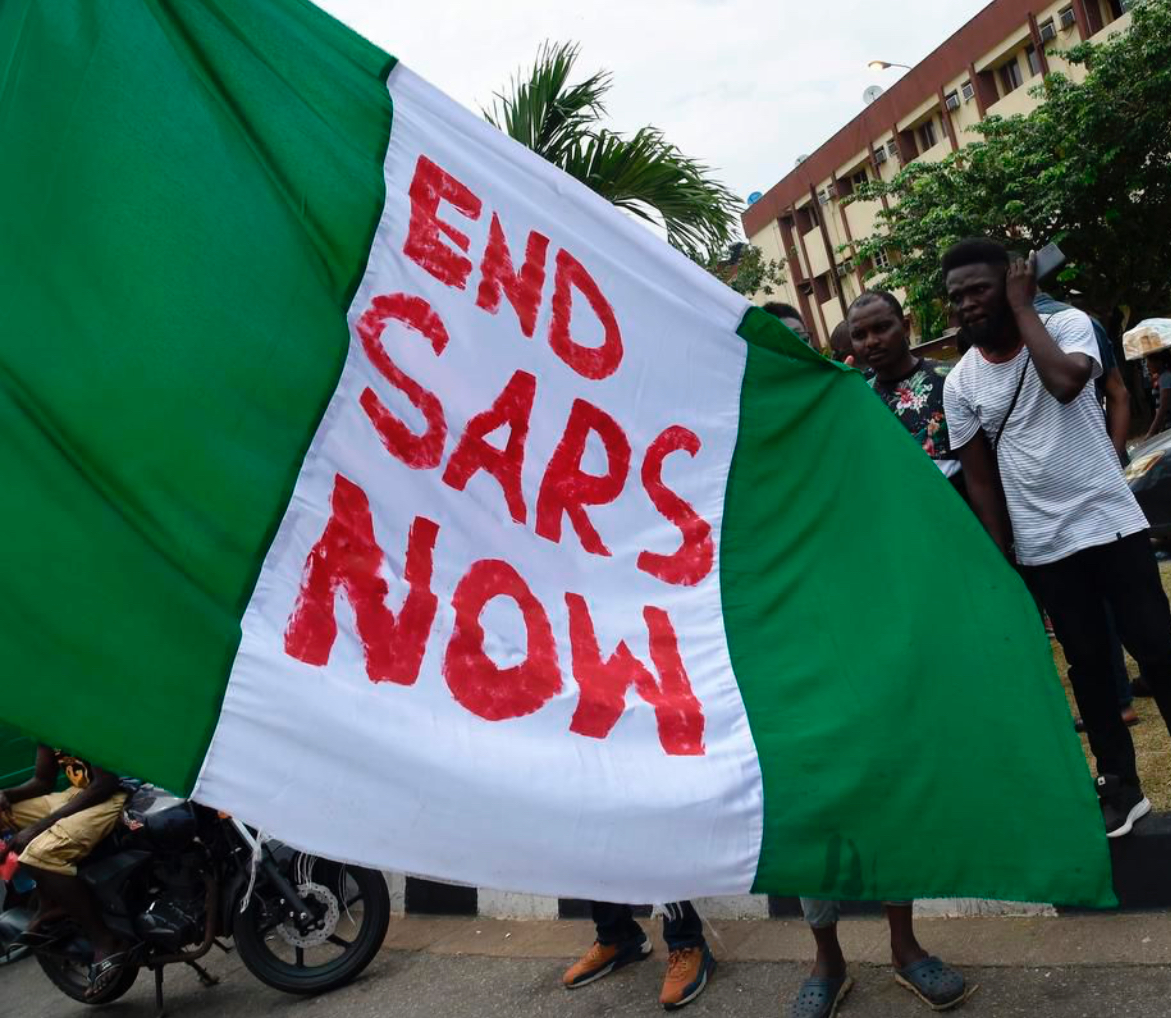
The atrocities committed by the Special Anti-Robbery Squad (SARS) are a reflection of the corrupted state of Nigerian law enforcement; and disdain for the lives and wellbeing of ordinary citizens that successive governments have demonstrated. Nigerians are suffering brutality and murder at the hands of police officers, soldiers, secret service agents, prison officials and road marshals. There is absolutely nowhere that they can turn to seek redress or reprieve. The governments feeble attempt to rebrand SARS as a new Special Weapons and Tactics (SWAT) Team shows how disinterested and out of touch it is.

Seismic changes are needed in law enforcement in Nigeria in order to reform the police. The emphasis has to be taken away from guarding the elite to tackling crime in a strategic and comprehensive manner. Critical to that will be disarming the rank and file police officers. Police officers should be trained in community policing and protecting the Nigerian populace. They need to learn how to carry out their duties unarmed and in a sensitive manner. This is what will give them the authority to effectively police the streets. Armed squads should be used in response to identified threats of armed attacks by criminals. Retraining in detecting crime will go some way to taking guns off, and improving safety on the streets. 

There is no possibility of reforming the Nigeria Police Force without completely reorganising, or possibly removing the entire senior officer corps currently at the helm. Every senior officer should be evaluated and assessed for honesty, competence and commitment. All those who fail the evaluation should be forced to resign or face being dismissed. All existing members of the police force should undergo a programme of development and retraining. The police force should be subject to new a governance framework with an independent board responsible for regulation and executive management at the helm. 

Of course, none of this would be possible unless there is a ruling government committed to anti-corruption, equity, transparency and reform. But then I guess it would also help to not have a prison system that is decrepit and inhumane, a judiciary that is full of negligent sellouts, a legislature populated by corrupt parasites; and political parties run by self serving immoral shysters. This government’s inept handling of the ‘End SARS’ protests shows that it is neither committed to nor capable of looking out for the welfare of the people or country of Nigeria.  

Tuesday, 14 January 2020

No Loss

When I was young my parents and elders would pacify us with sayings and aphorisms advocating delayed gratification. Gems such as; “not everything you like is good for you”, “you can’t always get what you want” and “your time will come”. As it turned out everything I liked actually did do me some good. I never actually got anything I wanted. And; as for my time coming, I’m still waiting. However, it is a fact that not getting something your heart was set on may be painful but doesn’t always amount to a loss in the greater scheme of things.

In 2016 I could not imagine the prospect of Trump becoming president of the USA. He was clearly a moronic megalomaniac. As it turned out millions of Americans disagreed with me. Proving the points  that you can’t always get what you want, and your time will come in one crushing blow. However, as much as I despised Trump I was very uneasy about the prospect of a Hilary Clinton presidency. Her losing, strangely enough, allowed me to make peace with Trump winning. In the UK I despaired at the thought of Boris Johnson remaining prime minister but couldn’t imagine any good coming of Jeremy Corbyn  being in charge, of anything. I didn’t expect Labour to lose so heavily but I did not shed any tears. In Nigeria, anyone with a memory or capable of reading knew that Buhari lacked vision and strength to turn the the country around but Jonathan Goodluck had facilitated such a corrupt cesspit that Nigerians preferred to jump off a cliff rather than re-elect him. As it turns out the bottom of that cliff is proving quite the rocky hell but good riddance to Goodluck.

At some point, all of us will experience or have experienced heartbreak in a relationship. Whether it is a rite passage or one of life’s necessary evils is of little consequence. Heartbreak comes to all people either by commission or omission. Some relationships go wrong because of a mess up, a refusal or inability to see things clearly, a bad fit; you name it. What is sure is that when it ends one or both parties may feel some measure of heartbreak. Whether it is justified or not the head and the heart will feel some separation anxiety. However there are times when in spite of this anxiety the spirit feels freed. Shattered and broken-hearted the spirit knows when it has taken a mauling even while the head is smiling widely and the heart is yelling c’mon! So even while a person is weeping uncontrollably and hurting like whiplash the spirit is skipping into the sunset sighing, “no loss!”.

For some recreational runners the main focus of running is getting up and setting off. Personal bests and records just aren’t the one thing occupying the mind once you hit the asphalt or track. Some days the run is bad and others it’s better. But that’s ok because you ran and you didn’t give up. Even if you race you don’t have to get put out by your time or placing. You just put your heart into it and knowing you did all you could is all you ask of yourself. As long as you don’t get injured not being devastatingly fast is just no loss.

You can be underwhelming, come up short and end up sub par. You can have your world turned upside down, heart ripped to shreds and be under appreciated. However, you need to know that not everything you lose is a loss.


Tuesday, 29 May 2018

Nigeria Born Again

copyright: Asukwo eb
Since the return of party politics in Nigeria following the demise of military dictator Sanni Abacha the country has made some considerable strides. The economy is considered one of the key emerging economies in the developing world. There has been widespread access to mobile communications and internet services. Business magnate Aliko Dangote is considered the richest man in Africa. However social conditions have deteriorated. Poverty, unemployment and deprivation are rife. Wealth inequality has gotten worse. Corruption continues unchecked.

A lot of hope has been vested in incoming governments to curb corruption and neglect; and get development back on track. To date no government has been able to deliver on its promises. The current government under Buhari promised to fight corruption, instability and deprivation. It is widely acknowledged that it has failed to do this to any appreciable extent. However, Buhari has expressed an intention to stand for election to a second term as president. There has been a lot of debate on whether based on his performance he can be considered a worthy candidate. It is almost certain his party will support his candidacy but he himself has not distinguished himself as a saviour with the vision or will to bring about change in the country.

It’s incredible that in 2018 Nigerians are still hoping for an election campaign based on integrity, social and economic vision, and an honest manifesto; instead of cash distribution combined with thug driven violence. We still don’t have candidates who can give a good account of their past stewardship. Campaigns are rife with false claims, empty promises and personal abuse. The electorate deserves better and needs to hold political aspirants to a higher standard. The only way change will happen is if a new cadre of politicians is ushered in. The country desperately needs people with a passion for public service who are not driven by a desire for personal enrichment.

Nigeria is currently beset by extensive poverty, a lopsided economy, inadequate rural investment, wide ranging unemployment, unchecked crime and regional violence, poor access to healthcare, erratic power supply, decline in quality of education, mass emigration, and inadequate public services. Any politician not talking about these issues over the next year cannot possibly have very much to offer. Any campaigns that are not centred around offering solutions to these problems would only be trying to pull the wool over our eyes. Any chance of a better future will depend on the electorate demanding a better class of politician; and asserting their rights to have a political system that serves the nation as a whole.


Saturday, 5 November 2016

Politics Makes Strange Bedfellows

Politics appears to be that one arena where partisanship is valued a lot more than higher principles. In order to get ahead in politics some people are forced to set aside their principles while others just completely abandon principle in favour of a front seat on the bandwagon. In the 2016 US presidential election a lot of people have lined up behind Clinton and Trump racked with no small degree of ambivalence, and through gritted teeth.

One politician who hasn't been too discriminating about entering one room or the other with people of dubious reputations has been Nigeria's President Buhari. He swept to power claiming to be a new broom committed to changing a culture of public fraud and corruption. However, he didn't hesitate to join forces with Atiku and Tinubu to rally support for his presidential bid. Both men have been tainted by accusations of enrichment in public office and facilitating fraud. Raji Fashola (the well loved former governor of Lagos State) who Buhari appointed to key ministerial portfolio failed to properly respond to claims that millions of public funds were spent on a personal website for him.

Hillary Clinton has appeared happy to apologise for things she has been found to be wrong about but never prepared to explain what really happened with the deletion of emails from her private sever, speeches she was paid to give on Wall Street or links between donations to the Clinton Foundation and her role as Secretary of State. Michelle Obama says she believes Hillary Clinton is a truly good and decent person. But she couldn't have forgotten the things Hillary said and did during the Democratic Party nomination contest with Barrack Obama. Hillary Clinton's appointment as Secretary of State was mainly intended to ease her bitterness and avoid any acrimony from her loss. Bernie Sanders is campaigning for Hillary but he knows that Hillary stands for everything he is opposed to. However Sanders knows that the best chance of adoption of any liberal policies is if Hillary becomes president.

Donald Trump's candidacy is literally ripping the Grand Ol Party a new one. A lot of Republicans are desperate for a return to the GW Bush era when social projects were a liberal evil and sleazy lobbying and corporate greed ruled the day. However there is a recognition that with Trump as president even these things are likely to be taken to such an extreme that the party will become so toxic that it will fall out of public favour and its members start to devour themselves. However most Republicans will get behind Trump even if there are more than a few who won't stand beside him.

There's nothing wrong with having someone new and inexperienced in the White House. What's required is someone with integrity and vision. Trump is definitely not that person. Unfortunately, neither is Hillary Clinton. 


Monday, 21 March 2016

Change That Beggars Belief

The new new Nigerian government was elected on a promise to change the corrupt and self serving government of the past regimes. It was going to sweep out corruption and misadminstration, and clean up the corrupt mess left by the previous government. That promise has proven to be an empty boast. It now appears that the faith placed in the new government by the people of Nigeria was misplaced. There was a delay in appointing ministers. It was hoped that this was to be ensure that the right people were appointed to take forward an agenda for change. It turns out that the delay was just another function of the government's inertia and lack of ideas. The appointees have proven less than impressive. 

The economy that has been left to drift. The ministry of finance tussling with the central bank for control of fiscal policy. This has led to economic stagnation with the foreign exchange market practically imploding. The stock exchange has crashed and then fallen even further. No tangible domestic economic strategy has been outlined. Even corporate taxation hasn't yet been radically reformed. The government presented a disastrous budget to the senate that had to be withdrawn. It so clearly didn't address the economic issues at hand or properly allocate funds to areas of greatest need. The government has been focused on obtaining bridging loans rather than securing investment. Little has been done to diversify the economy and move it from a predominantly services base to a more manufacturing one. 

The minister for services rushed into the breach with a strategy document but failed to do his due diligence or any impact assessments. Lofty ambitions of managing power and developing infrastructure have rapidly been overwhelmed by the need to just keep things running. As it turns out operational continuity has lost out to poor planning and incompetence. Almost every month of this new government has seen fuel shortages. Electricity supply has fallen to new lows. Something that is almost unimaginable given how usually poor it is. 

Law and order in the country seem to be breaking down in a lot of states. Elections in Rivers state recently provoked calls for the imposition of a state of emergency. Fulani herdsmen seem to be rampaging unchecked, laying waste to villages and murdering women and children on a regular basis. Certain elements have started a campaign for a so called 'Biafra state'. This agitation has been tackled in a heavy handed manner. A radio show host arrested, detained and arraigned in court on charges of treason and sedition. More time has been spent briefing about how Boko Haram has been defeated than on actually tackling the terrorist menace itself. 

The government has become increasingly associated with misinformation and spin. Campaign promises have been watered down or at times denied outright. A campaign pledge to offer an allowance to the unemployed was first scorned by the president in a webchat in December and is now being said to have never been made at all. It appears that contrary to President Buhari's declaration that his experience of democracy has changed him from a military dictator; he appears to be increasingly leaning towards a militaristic totalitarian approach to governing. 

A lot of work has gone into probing the huge amount of corruption linked to the previous government. However, this appears to be an excuse for the government's inaction on a whole raft of other areas of public service. To date it appears that tackling corruption is the only policy that government is actually pursuing.

There is no doubt that the previous government left services and the infrastructure of government in a sorry state. However, this was always the task at hand when President Buhari campaigned for election and when he assumed office. Continuously pointing it out has worn thin on the citizenry and shows an element of cluelessness in a government that promised so much and claimed to have the answer to the country's problems. President Buhari is at the helm of an administration that is presiding over an unprecedented level of social and personal difficulties for Nigerians. His credibility, like his approval ratings is at an all time low. He needs to take a step back and come up with a more considered action plan to address all that is currently going wrong in the country. More importantly though, it needs to embody real change and act to reverse the poor performance and perception of the administration.